

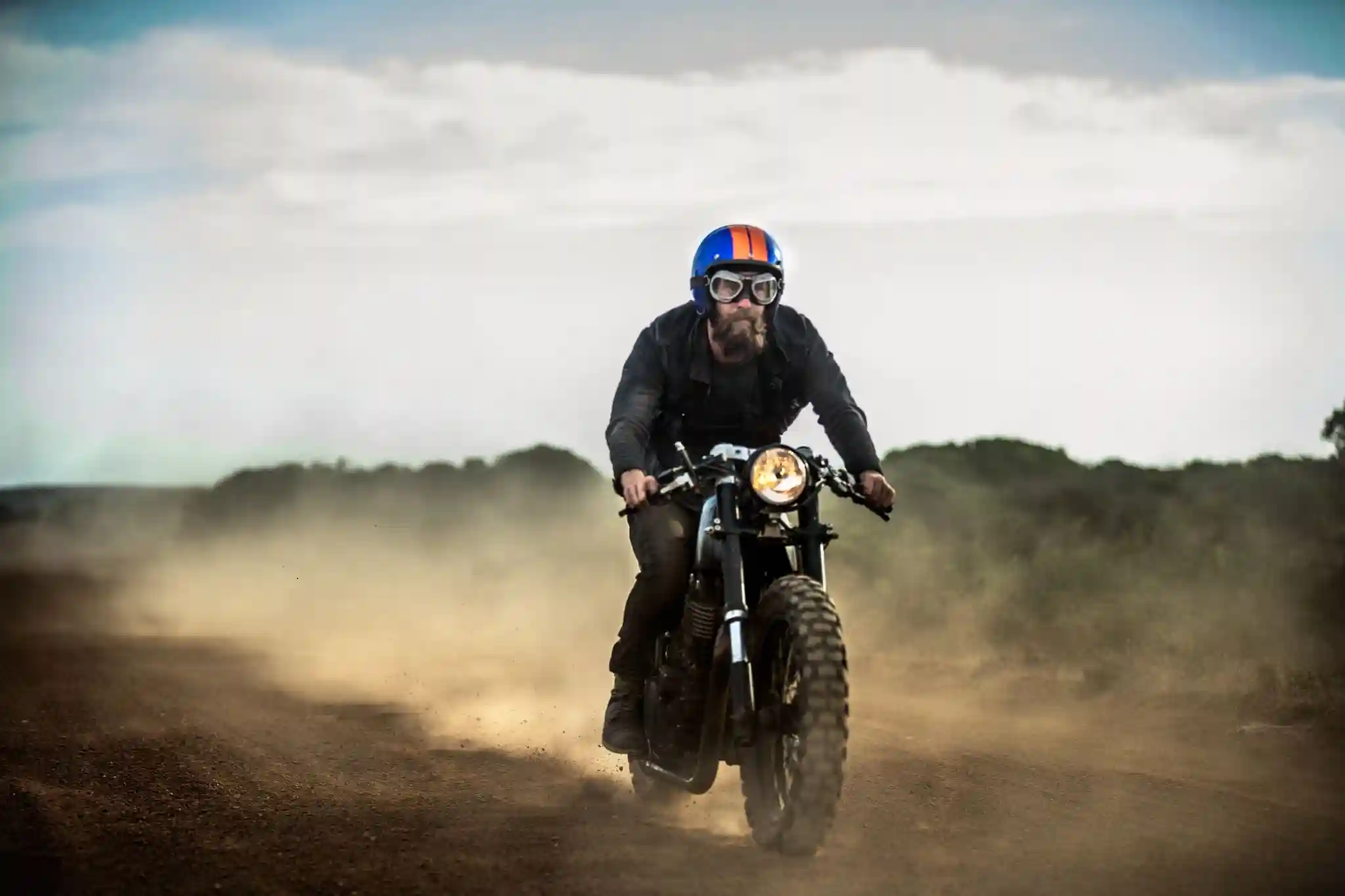
There is a moment at the start of every motorcycle race that spectators rarely appreciate fully from the grandstand. The grid is set. Engines are screaming at temperatures that would destroy a road engine in minutes. The riders sit completely still inside a wall of noise and heat and pressure that would overwhelm most people before the lights even go out. And then the start happens in a fraction of a second, a controlled explosion of throttle and clutch and body position that requires the simultaneous execution of a dozen physical inputs, any one of which, performed incorrectly by a margin measured in millimeters or milliseconds, ends the race before it has truly begun.
The Physical Architecture of Motorcycle Racing Demands
The human body was not designed for the physical environment that motorcycle racing creates. Even a brief analysis of the specific forces that a racing rider experiences during a typical lap reveals a physiological challenge that is significantly greater than most spectators appreciate when they watch racing on television or from trackside.
Braking forces represent one of the most extreme physical demands in racing. A MotoGP machine braking from 340 kilometers per hour to the 60 kilometers per hour required for a tight corner generates deceleration forces approaching 1.4g, which the rider experiences as a force pushing them forward over the handlebars that must be resisted entirely through their own muscular effort. The primary muscles doing this work are the core, the shoulders, the forearms, and the hands, all of which must maintain precise force application to the brake lever simultaneously with resisting the deceleration force trying to slide the rider forward. This happens dozens of times per lap, across dozens of laps, and the cumulative muscular fatigue it creates is substantial even for athletes at peak physical condition.
Neck and Core Conditioning as Competitive Variables
The specific physical conditioning demands of motorcycle racing have been studied in sports science contexts with increasing sophistication as the sport has professionalized, and the findings confirm what experienced riders and trainers have long understood empirically. Neck strength is one of the most important and most underappreciated physical requirements of motorcycle racing, because the helmet worn by a racing rider weighs approximately four to five kilograms and is subjected to the same g-forces as the rest of the body under acceleration, braking, and cornering. A rider experiencing 1.4g braking is effectively supporting a six to seven kilogram load on their neck through the helmet, and they are doing this repeatedly, dozens of times per lap, for the duration of the race.
The Cognitive Demands That Set Racing Apart
Physical capacity is the necessary foundation of motorcycle racing performance, but it is not sufficient. The cognitive demands of racing at the highest level are equally extraordinary and equally continuous, and they interact with physical fatigue in ways that make the management of both simultaneously one of the sport’s defining challenges.
A MotoGP rider navigating a circuit at racing speed is processing an estimated 200 decisions per lap, ranging from the macro decisions of racing line selection and tire management strategy to the micro-decisions of throttle application timing and body position adjustment that happen in timeframes too short for conscious deliberation. The capacity to execute these decisions accurately, consistently, and without the kind of cognitive hesitation that costs tenths of seconds and sometimes causes crashes, is the product of years of track-specific learning that builds the automatic, pre-conscious pattern recognition that elite motor performance relies on.
The Mental Challenge of Risk and Consequence
The cognitive demands of motorcycle racing include a dimension that is uniquely significant in this sport compared to most other athletic disciplines: the management of genuine, continuous risk of serious injury and death. The consequences of errors in motorcycle racing are not the dropped ball or missed shot of lower-consequence sports. They are crashes at speeds that regularly exceed 200 kilometers per hour, with physical consequences that range from painful minor injuries to severe trauma to fatalities. Every rider on the grid is aware of this reality. Every lap they compete involves making decisions whose margin for error includes the possibility of catastrophic consequence.
Endurance Racing and the Extreme End of the Physical Spectrum
While sprint racing formats like MotoGP represent the highest levels of speed and technical skill in motorcycle competition, endurance racing disciplines push the endurance dimension of motorcycle racing skill and endurance to extremes that sprint formats cannot approach. Events like the Bol d’Or and the Suzuka 8 Hours require racing teams to keep a motorcycle competitive for eight hours of continuous racing, with rider changes allowing each individual rider to manage physical fatigue across multiple stints. The 24 Hours of Le Mans for motorcycles represents the most extreme endurance challenge in the sport, with teams and riders managing a full day of racing through variable weather, darkness, and the cumulative fatigue that twenty-four hours of racing produces.
In these endurance formats, the skill and endurance requirements do not simply add together. They interact in ways that create challenges distinct from either pure sprint racing or pure endurance athletics. A rider taking over a motorcycle after a three-hour stint by a teammate must immediately achieve racing pace on a motorcycle whose tires have specific temperature and wear characteristics, on a track whose conditions may have changed, against competitors whose positions and strategies are evolving. The cognitive and physical transition from rest to racing-speed performance must happen in seconds and must be sustained at competitive intensity for a stint length determined by fuel capacity, tire wear, and team strategy rather than by the rider’s optimal fatigue management preference.
Off-Road and Extreme Endurance: The Isle of Man TT and Rally Racing
The Isle of Man TT occupies a singular position in the hierarchy of motorcycle racing challenges because it combines the speed demands of circuit racing with the risk profile and course complexity of an open-road environment that no other major motorsport event replicates. The Snaefell Mountain Course covers 60.72 kilometers of public roads with over 200 corners, dramatic elevation changes, varying surface conditions, and a race environment in which riders navigate blind crests at speeds exceeding 290 kilometers per hour on roads lined by stone walls, lampposts, and domestic architecture that leaves no margin for error.
The cognitive demands of the TT are categorically different from those of circuit racing because the course cannot be learned through continuous repetition the way a purpose-built circuit can. Riders study the course through video reference, road-based reconnaissance at legal speeds, and the accumulated knowledge of multiple previous races, but they race on roads whose surface, camber, and condition changes with weather in ways that a fixed circuit does not. The memory load required to race the TT at competitive speeds is immense: every corner, every crest, every surface anomaly across sixty kilometers of complex road must be held in memory with sufficient precision to make correct decisions at speeds that allow no time for conscious deliberation.
The Role of Technology in Amplifying Rider Capability
Modern motorcycle racing takes place on machines whose technological sophistication represents one of the most extraordinary convergences of engineering capability in motorsport. A MotoGP machine is a rolling technology laboratory, deploying electronics systems of a complexity that rivals aerospace applications, and understanding how to work with these systems rather than against them is a significant and evolving dimension of racing skill.
Traction control, anti-wheelie, engine braking management, launch control, and the sophisticated seamless-shift gearboxes of modern prototypes all interact with rider inputs in ways that require the rider to understand the system’s behavior in order to optimize it rather than simply accepting the system’s defaults. The fastest MotoGP riders are not simply the most physically talented or the most mechanically skilled in the traditional sense. They are also the most sophisticated in their ability to provide the engineering feedback that allows their technical teams to optimize the electronics package for their specific riding style and for the specific conditions of each circuit and each race.
Final Thoughts
Motorcycle racing skill and endurance are not separate qualities that the sport happens to require simultaneously. They are inseparable aspects of a single integrated athletic and cognitive performance that places demands on the human body and mind that few other activities in human experience can match. The physical capacity to sustain precise, high-force muscular output across the duration of a race, the cognitive capacity to make accurate high-speed decisions continuously while managing competitive awareness and strategic information, the psychological capacity to operate at the limit of human capability in an environment where the consequences of error are genuinely severe, and the technical sophistication to work with and optimize complex machine systems under all of these simultaneous pressures, together constitute a performance challenge of remarkable depth and breadth. This is why motorcycle racing has captivated audiences and attracted extraordinary athletes for more than a century.